A Long-Awaited Public Market Debut
SpaceX has officially filed for an initial public offering, marking one of the most anticipated transitions from private to public markets in over a decade. As the largest and most influential component of the Prime Unicorn Index, SpaceX’s move is not just a company milestone, it is a broader signal that the IPO window for elite, late-stage private companies may be reopening.
While specific pricing details and timing have not yet been finalized, early indications suggest the offering could value SpaceX well above its most recent private market valuation, which has hovered around $1.2 trillion. Depending on market conditions, the IPO could become one of the largest in U.S. history, rivaling offerings such as Alibaba (2014) and Saudi Aramco (2019).
What Investors Are Buying
SpaceX’s investment case is built on two core businesses that together define its long-term growth trajectory. The first is its launch division, which has established a dominant position in orbital launches through reusable rocket technology. The second, and increasingly more important, is Starlink, the company’s satellite-based internet network.
Starlink has rapidly scaled into a global connectivity platform, serving millions of users across residential, enterprise, and government markets. More importantly, it generates recurring revenue, a key factor that may support a premium valuation multiple relative to traditional aerospace companies.
Strategic Implications
The IPO represents a critical liquidity event for early investors and employees, many of whom have held shares for years in private markets. It also provides public market investors with direct exposure to a company that sits at the intersection of aerospace, telecommunications, and national security.
More broadly, SpaceX going public could have a ripple effect across the private market ecosystem. As one of the most visible and valuable unicorns transitions to public markets, it may pave the way for other late-stage companies to follow, particularly those with strong revenue growth and clear market leadership.
For the Prime Unicorn Index, this event is especially significant. SpaceX has been a cornerstone component, frequently highlighted in investor outreach and index performance narratives. Its IPO will not only validate its scale and investor demand but may also serve as a benchmark for how private market valuations translate into public market pricing.
In Other Major Funding News: Open AI and Whoop Major Funding Rounds
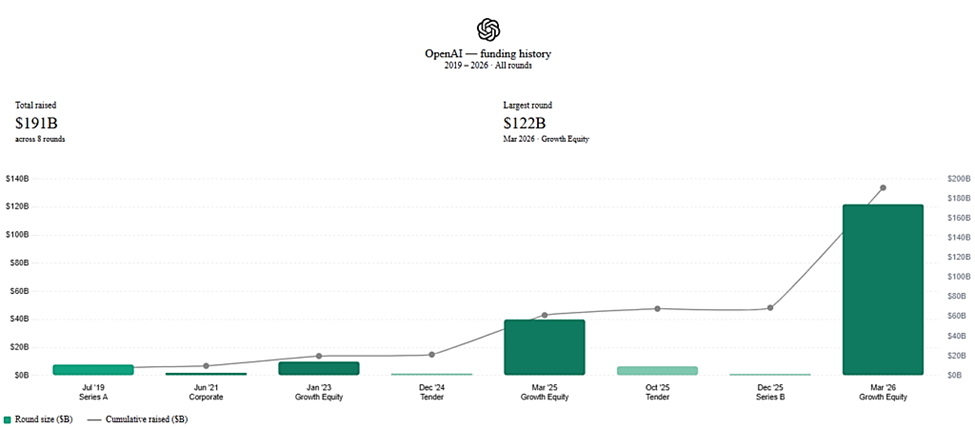
On Tuesday, OpenAI announced a $122 billion funding round, the largest private capital raise ever recorded. The round includes a combination of committed capital and strategic investment aimed at accelerating the company’s next phase of development.
Including prior rounds, OpenAI has now raised an estimated $191+ billion in total funding, reflecting the unprecedented capital requirements associated with training and deploying frontier AI systems. The company indicated that proceeds will be directed toward expanding compute infrastructure, advancing next-generation models, and scaling its product ecosystem across enterprise and consumer applications.
The magnitude of this raise reinforces OpenAI’s position as the clear leader in the generative AI race and highlights the degree to which capital is concentrating in a small number of platform-level AI companies.
Whoop Expands Global Health Platform with New Funding
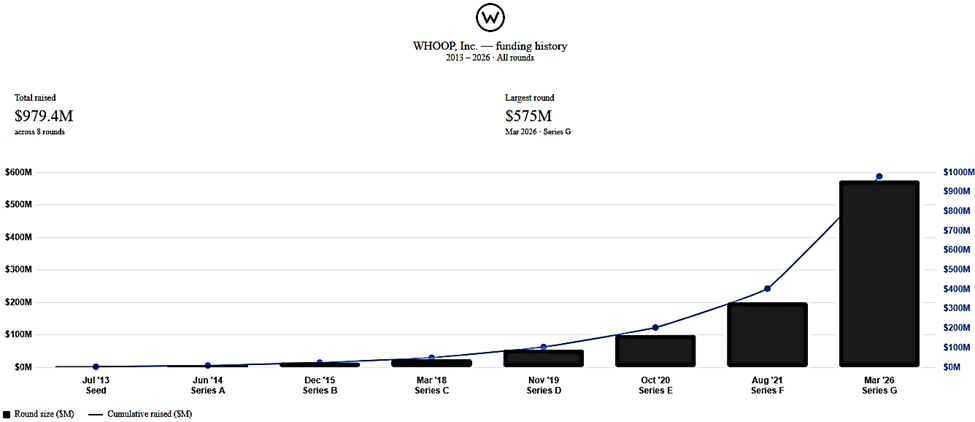
Whoop also announced a significant capital raise, securing $575 million in Series G funding at a valuation of approximately $10.1 billion. The round brings the company’s total funding to over $900 million since its founding.
The company continues to differentiate itself through a subscription-based model that prioritizes performance insights, recovery tracking, and continuous health monitoring over one-time hardware sales. With operations now spanning 50+ countries, Whoop is positioning itself as a global, data-driven health platform rather than a traditional wearable device company.
Proceeds from the round are expected to support international expansion, product innovation, and deeper investment in analytics and personalized health insights.
Why This Matters
This week’s developments highlight two defining trends in private markets. First, the IPO pathway for elite unicorns may be reopening, with SpaceX leading the way as a flagship example. Second, even as capital becomes more selective, category leaders continue to attract outsized funding, as seen with OpenAI and Whoop.
For investors tracking the Prime Unicorn Index, these events reinforce a central theme: the most valuable private companies are not only maintaining their leadership positions but are also increasingly shaping the next phase of public market opportunities.