
As summer vacation season approaches, millions of travelers are preparing for flights, road trips, concerts, sporting events, and weekends away. Over the past decade, few companies have changed how people move around cities and travel destinations more than Uber Technologies.
Founded in 2009 by Travis Kalanick and Garrett Camp, Uber began with a simple idea: making transportation as easy as pressing a button on a smartphone. What started as a luxury black-car service in San Francisco quickly evolved into one of the largest ride-sharing platforms in the world.
Uber’s model centered on convenience, accessibility, and flexibility. By connecting riders directly with drivers through a mobile app, the company transformed the traditional transportation industry and helped popularize the broader “gig economy” model that would later spread across multiple industries.
The Unicorn Moment
Uber became one of Silicon Valley’s earliest and most recognizable unicorns as investors rapidly embraced the company’s disruptive business model. By 2013, Uber had officially reached unicorn status following a $363 million Series C funding round led by Google Ventures and TPG Capital.
As smartphone adoption accelerated globally, Uber expanded aggressively into new cities and international markets. Investors viewed the company not simply as a transportation platform, but as a technology company capable of reshaping urban mobility on a global scale.
Over the following years, Uber raised billions from investors including SoftBank, Benchmark, Fidelity, and Saudi Arabia’s Public Investment Fund. At its peak as a private company, Uber reached an implied valuation of approximately $76 billion before going public in 2019.
Where Uber Stands Now
Uber went public in May 2019 under the ticker symbol “UBER,” marking one of the most anticipated technology IPOs of the decade.
Since its IPO, the company has expanded far beyond ridesharing. Uber Eats became a major growth driver during the COVID-19 pandemic, while the company also invested heavily in logistics, freight, and mobility infrastructure.
Today, Uber operates across dozens of countries and facilitates millions of rides and deliveries each day. Its platform has become deeply integrated into modern travel and city transportation, particularly during busy summer travel periods when demand for flexible transportation solutions tends to rise.
Uber’s evolution also reflects broader changes in consumer behavior. Travelers increasingly prioritize on-demand convenience, app-based services, and flexible transportation options over traditional car rentals or taxi systems.
Market Moves Since IPO
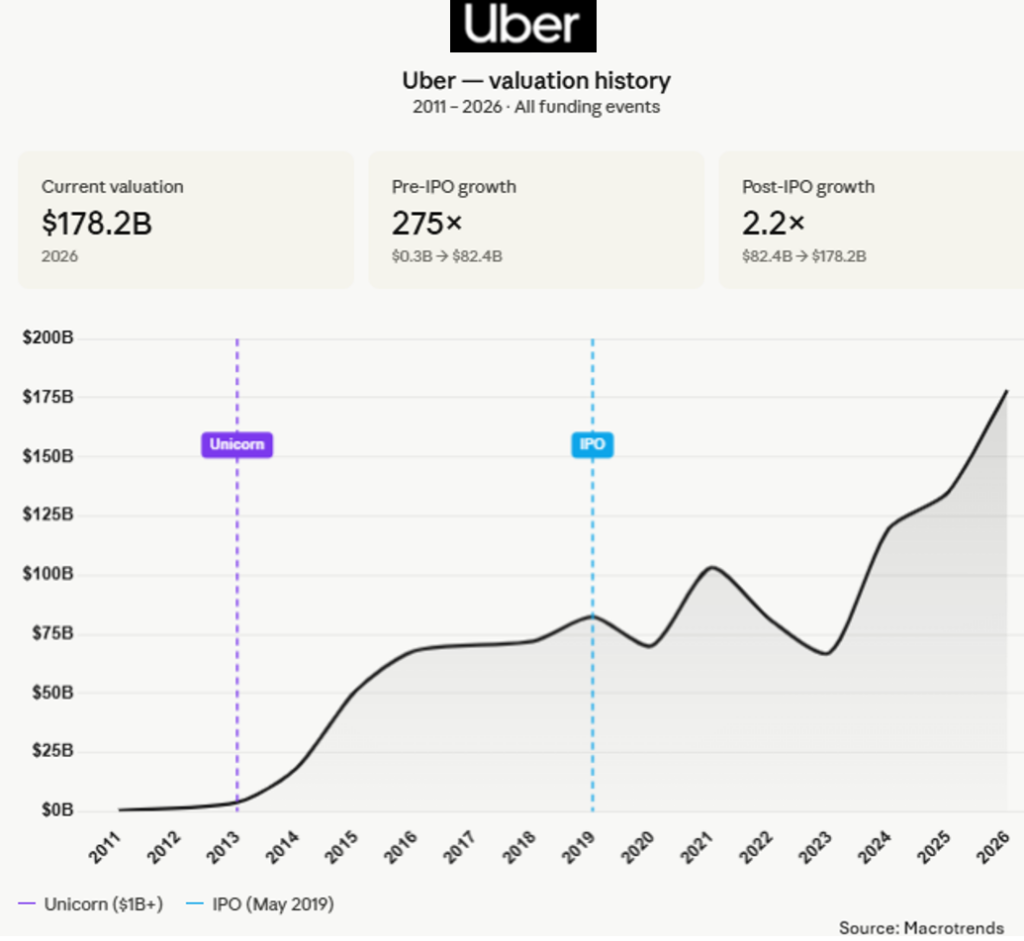
Uber’s valuation history illustrates how much value creation occurred while the company was still private. Between its early funding rounds and IPO, Uber’s valuation increased from approximately $300 million to over $82 billion, representing roughly 275x growth. Since going public in 2019, Uber’s valuation has grown at a much slower pace, reinforcing a broader trend in which many high-growth technology companies generate the majority of their returns prior to entering public markets.
Like many former unicorns, Uber experienced significant volatility following its transition to public markets. The company faced questions surrounding profitability, regulation, labor classification, and competition across key markets.
Despite these challenges, Uber has continued expanding its ecosystem and improving operational efficiency. In recent years, the company has moved closer toward sustained profitability while maintaining a dominant global presence within ride-sharing and delivery services.
More broadly, Uber’s journey highlights how much value creation occurred while the company was still private. Long before its IPO, Uber had already become one of the world’s most valuable startups, reinforcing a broader trend in which substantial growth increasingly takes place in private markets rather than public ones.
Looking Ahead
As travelers prepare for summer vacations, concerts, and weekend trips, Uber remains a central part of the modern travel experience. Its ability to combine technology, convenience, and scalability helped redefine urban transportation and permanently reshape consumer expectations around mobility.
Uber’s rise from startup to unicorn to public company remains one of the defining private market stories of the past decade, illustrating how technology can transform even the most established industries.
Want more data on Unicorn companies, including funding and valuation history, secondary transactions, and more? Email Contact@PrimeUnicornIndex.com or Call 646-290-9254