The fintech sector represents one of the most important segments within the Prime Unicorn Index Composite, reflecting how technology continues to reshape payments, banking, lending, wealth management, payroll, and financial infrastructure. Because many leading fintech companies remain private, the sector also highlights why early private market visibility matters. The Prime Unicorn Index helps track where innovation, capital formation, and value creation are occurring before these companies reach public markets.
The Prime Unicorn Composite Index currently includes 20 fintech companies, highlighting the breadth of innovation taking place across private financial technology markets. Four of those companies, Ripple, Bilt, Gusto and Upgrade, are also represented in the Prime Unicorn 30™ Index, underscoring fintech’s continued importance within the broader private market landscape.
Over the past decade, fintech has evolved from a narrow category focused mainly on payments and online lending into a much broader ecosystem. Today, private fintech companies are building infrastructure for digital assets, embedded finance, consumer rewards, small business banking, payroll, retirement, insurance, and spend management. Because many of these companies remain private, traditional public market data only captures part of the fintech story. Tracking this sector through the Prime Unicorn Index provides earlier visibility into where financial innovation and value creation are occurring before companies reach public markets.
Sector Performance
Since May 2024, the PUI Fintech Industry Average has returned approximately +75.0%, compared to +173.4% for the Prime Unicorn 30™ Index over the same period. While fintech has delivered meaningful gains, it has underperformed the broader index by approximately 98.4 percentage points. This relative performance is exactly why sector-level private market data matters. It allows investors and market observers to see not only which private companies are growing, but also which sectors are leading, lagging, or recovering within the broader unicorn market.
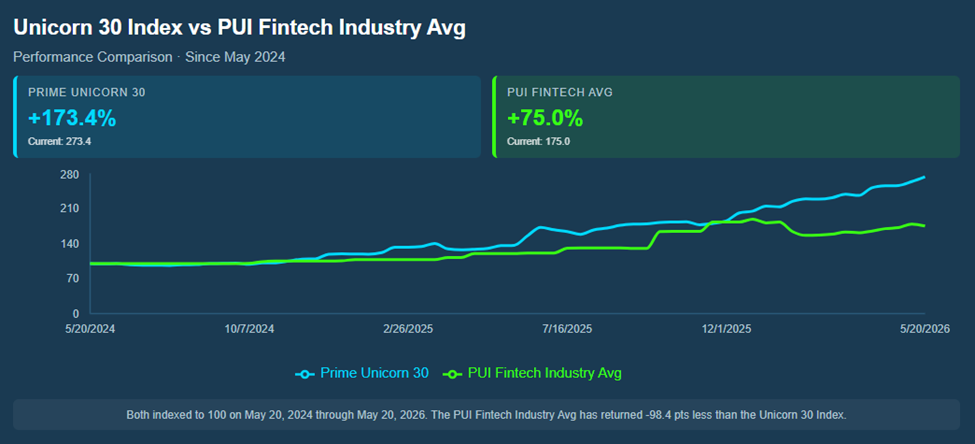
This performance gap reflects the unique position of fintech within today’s private market. While the sector remains highly innovative, investor momentum has been especially concentrated in artificial intelligence, defense technology, and large-scale infrastructure companies. Fintech, by comparison, has experienced a more measured recovery following the valuation reset that affected many high-growth financial technology companies after 2021.
Still, the sector remains strategically important. Companies like Plaid continue to serve as core financial data infrastructure, helping consumers securely connect bank accounts to apps and services across the fintech ecosystem. On its homepage, Plaid notes that one in two banked U.S. adults use its network, underscoring its role as a foundational layer of digital finance.
Key Theme: Financial Infrastructure Moves Private Market
One of the defining trends in fintech is the shift of financial infrastructure into private technology platforms.
Rather than simply offering consumer-facing apps, many fintech companies now provide the underlying systems that help businesses move money, manage employees, issue payments, underwrite loans, administer benefits, and track ownership. Carta, for example, describes its platform as an end-to-end suite for private capital, connecting equity, fund, and portfolio management. Gusto serves more than 500,000 businesses nationwide with payroll, benefits, and HR tools, while processing tens of billions of dollars in payroll each year.
This infrastructure role is important because it makes fintech companies deeply embedded in the financial operations of businesses and consumers. As these platforms scale, they can become difficult to replace, creating durable private market value before companies ever reach public markets.
Why the Fintech Sector Remains Important
Although fintech has underperformed the Prime Unicorn 30™ Index since May 2024, its continued growth demonstrates that private market innovation is not limited to one theme. AI may be driving the current market narrative, but fintech remains central to how money moves, businesses operate, and consumers interact with financial services.
For investors and market observers, the Prime Unicorn Index Fintech Industry Average provides a clearer view into this segment of the private market, helping benchmark performance, identify emerging trends, and understand where future value creation may be taking place.
Want more data on Unicorn companies, including funding and valuation history, secondary transactions, and more? Email Contact@PrimeUnicornIndex.com or Call 646-290-9254