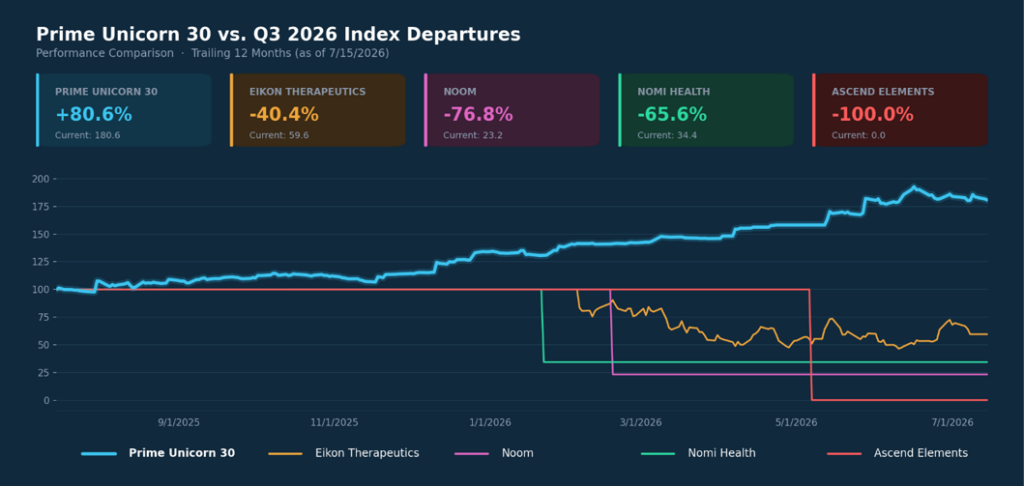
Every quarter, the Prime Unicorn Index reconstitutes to reflect the current state of the private markets, adding newly minted unicorns and removing companies that no longer qualify. This quarter’s departures are a useful reminder that crossing the $1 billion threshold is a milestone, not a guarantee. A valuation is only as good as the last time someone actually priced it, and in the private markets, that can be years out of date. This quarter’s departures highlight what happens when the Prime Unicorn Index’s current pricing identifies companies that no longer meet unicorn status. Four companies are leaving the index this quarter due to valuation changes, with two dropping below $1 billion in valuation, one repriced by the same rule, and one lost to bankruptcy entirely. Together, they show why tracking real, current pricing matters more than repeating a headline number from years ago.
Eikon Therapeutics is the cleanest example of “public doesn’t mean safe.” The clinical-stage biotech raised over $1.1 billion privately before going public in February 2026 at $18 a share, targeting a valuation just under $1 billion even at its debut. It’s been sliding since, down to roughly $12 a share and a market cap near $650 million by early July. As a pre-revenue company, its price now swings on trial data and analyst sentiment alone. BofA still rates Eikon a Buy with a $32 target, while Wedbush has it at Sell with a $5 target. Liquidity didn’t solve Eikon’s valuation problem; it just made the repricing visible in real time.
Noom shows the opposite problem: a valuation that looks fine on paper because nobody’s updated it. Most databases still list Noom at the $3.7 billion mark it set in 2021, as the company hasn’t had a new primary round since. But secondary market pricing tells a very different story, implying a value closer to $816 million today, in line with independent estimates from Nasdaq Private Market’s own secondary desk. The gap between the stale headline number and the real one didn’t appear overnight; it built up over years of product stagnation, heavy ad-driven customer acquisition, and disruption from GLP-1 drugs reshaping the weight-loss category, then simply went unpriced until the market caught up.
Nomi Health is a version of the same story, playing out on a longer delay. In August 2025, the direct-healthcare company took an investment from Inspirit Equity, a private equity firm whose entire strategy targets companies valued under $300 million. That’s a strong signal Nomi’s real valuation had already fallen well below its earlier venture-stage marks. It took until January 2026 for that reality to show up in pricing, a five-month lag that’s a normal feature of private markets, where disclosure is voluntary and infrequent. Notably, Nomi hasn’t stopped operating or signing new partners through the drop; this is a repricing, not a company in crisis.
Ascend Elements is the one true loss. The battery recycling company raised over $1.1 billion and reached a $1.5 billion valuation before filing for Chapter 11 bankruptcy in April 2026, after the federal government canceled a $316 million grant for its Kentucky facility, on top of falling material prices and a slowing EV market. It wasn’t alone. Rival recycler Li-Cycle also entered bankruptcy protection in 2025, suggesting an industry-wide timing problem more than a company-specific failure. Its equity is now marked at zero.
These four departures make the same point in four different ways: a valuation is only as good as the last time someone actually priced it. Public markets, primary rounds, and press releases all lag reality to some degree, and in the meantime, real capital is trading hands on what a company is actually worth right now. That’s precisely the liquidity the Prime Unicorn Index is built to capture, not just who’s a unicorn today, but how quickly that status can change, and how early the signs are visible to anyone tracking the right data.