Spotify at a Glance
As summer road trips give way to back-to-school playlists and study sessions, it’s a fitting time to look back at the platform soundtracking so much of it: Spotify. Founded in April 2006 in Stockholm by Daniel Ek and Martin Lorentzon, Spotify was created at a time when music piracy was reshaping the industry. Ek, who had briefly served as CEO of µTorrent, believed the best way to compete with illegal downloading was to offer a legal streaming experience that was faster, easier, and more convenient for listeners. Spotify launched across Europe in October 2008 with a freemium model: users could listen for free with ads or pay for an ad-free subscription. That approach helped reshape how consumers access music and became one of the defining models of the streaming era.
The Unicorn Moment
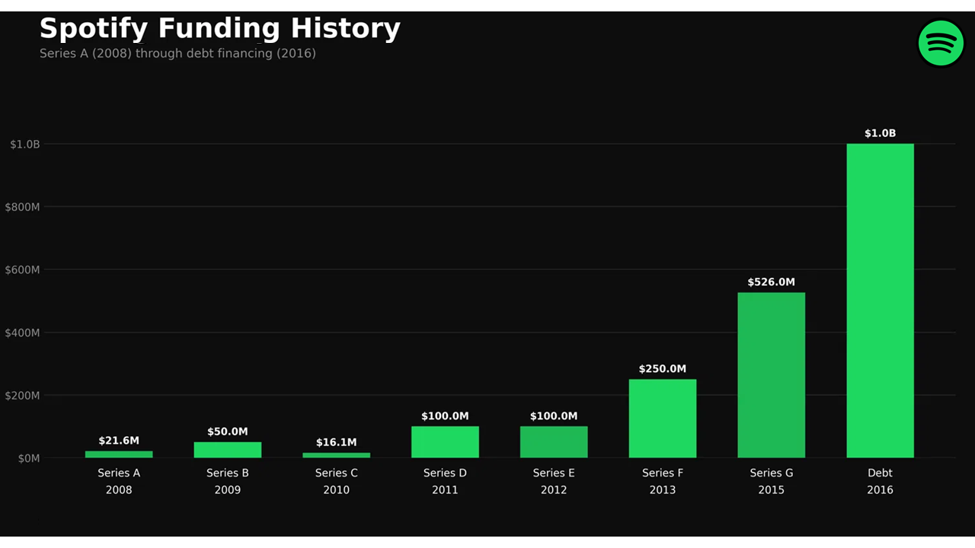
Spotify crossed the $1 billion mark in June 2011, when it raised a $100 million round backed by DST Global, Kleiner Perkins, and Accel. From there, growth was fast. By late 2013, the company was valued at nearly $4 billion. By 2015, that number had climbed to roughly $8.4 billion, driven by rapid international expansion and a subscriber base that kept compounding.
Where It Stands Now
Spotify went public on April 3, 2018, on the NYSE under the ticker SPOT, but it skipped the traditional IPO playbook entirely. Instead of hiring underwriters to price and sell new shares, Spotify opted for a direct listing, letting existing shareholders sell directly to the public with no new capital raised. The NYSE set a reference price of $132. Shares opened at $165.90 and closed their first day at $149.01, valuing the company above $26 billion. It remains one of the most closely studied direct listings in tech history, and it helped pave the way for companies like Slack and Coinbase to go public the same way.
Market Moves Since Its Public Debut
Spotify (SPOT) recently traded around $550 per share, giving the company a market capitalization of roughly $113 billion. Spotify’s most recent quarter marked another milestone: 300 million Premium Subscribers and 777 million monthly active users. Q2 revenue reached €4.78 billion, while net income totaled €545 million.
Why Tracking Private Markets Matters
Spotify’s story is a useful reminder of why the Prime Unicorn Index exists. Between its 2011 unicorn round and its 2018 public-market debut, Spotify’s valuation grew from roughly $1 billion to $26.5 billion. Much of that value creation occurred while the company was still private and inaccessible to most public-market investors. Anyone tracking private valuations along the way would have seen the company’s trajectory years before Wall Street had the chance to buy in.
That’s the core value of watching private markets closely. Long before a direct listing, an IPO, or a headline-making acquisition, a company’s valuation is already telling a story. The Prime Unicorn Index exists to make that story visible, tracking how today’s private companies are valued long before the public ever gets the chance to own a piece of them.
Spotify shows how much value creation can happen entirely out of public view. It’s a pattern worth watching for, because the next Spotify is out there right now, still private, and still building.
Want more data on Unicorn companies, including funding and valuation history, secondary transactions, and more? Email Contact@PrimeUnicornIndex.com or Call 646-290-9254.