
From Crypto Payments to Financial Infrastructure
Welcome back to Unicorn Spotlight, a series where we highlight standout companies within the Prime Unicorn Index.
Founded in 2012, Ripple has spent more than a decade building infrastructure around blockchain-based payments and digital assets. While the company is still closely associated with XRP and the XRP Ledger, its business has expanded well beyond cross-border payments. Today, Ripple operates across payments, custody, stablecoins, prime brokerage, and treasury management, positioning itself as a broader provider of digital asset infrastructure for institutions.
Building Beyond Payments
Ripple’s original value proposition centered on making cross-border payments faster and more efficient. That remains an important part of the business, but recent acquisitions have significantly broadened its reach.
In 2025, Ripple acquired prime broker Hidden Road for $1.25 billion, later rebranding the business as Ripple Prime. The platform clears more than $3 trillion annually across markets and serves more than 300 institutional customers. Ripple also acquired treasury-management provider GTreasury for $1 billion. The business now operates as Ripple Treasury, expanding Ripple’s presence in corporate cash, liquidity, and risk management. Together, the deals push Ripple deeper into the infrastructure used by financial institutions and large corporations.
Stablecoins and Regulatory Expansion
Ripple is also building around Ripple USD, or RLUSD, its U.S. dollar-backed stablecoin launched in late 2024. By June 2026, RLUSD had reached approximately $1.7 billion in market capitalization, with Ripple positioning it for use in payments, tokenization, and collateral management.
Regulatory clarity has also improved. In August 2025, Ripple and the SEC dismissed their respective appeals, resolving the long-running civil enforcement action, although the court’s final judgment and $125 million penalty remained in place. In July 2026, Ripple also received full MiCA authorization in Luxembourg, allowing it to provide regulated cryptoasset services across the European Economic Area.
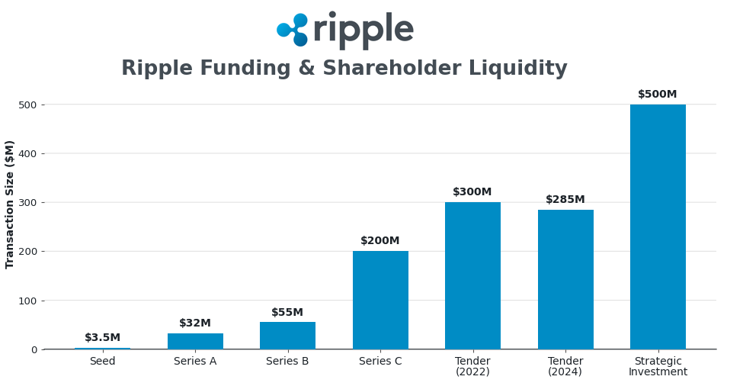
Ripple’s growth has been supported by a mix of outside investment and shareholder liquidity programs. After raising $200 million in its 2019 Series C, Ripple later repurchased shares from existing investors and employees through tender offers, before returning to outside capital with a strategic investment in 2025.
Valuation and the Prime Unicorn Index
Prime Unicorn Index data currently values Ripple at approximately $18.1 billion. Ripple ranks No. 7 in the Prime Unicorn Index and carries a 3.27% weighting, making it one of the more significant constituents in the Index.
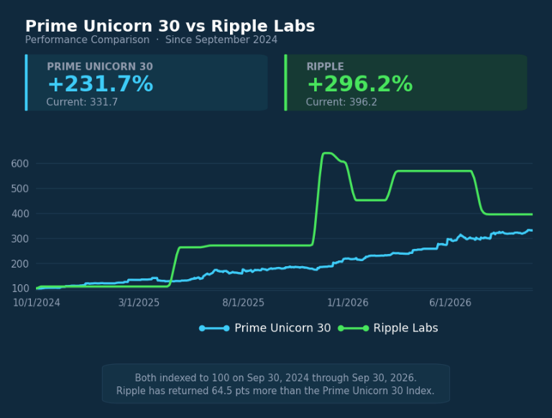
Its two-year PUI price history also shows how meaningfully private-market pricing can change over time. From September 2024 to September 2026, Ripple’s PUI price increased from $26.50 to $105, a gain of roughly 296%, while reaching as high as $170 during the period. Over the same period, Ripple outperformed the Prime Unicorn 30 by approximately 64.5 percentage points. That movement highlights the importance of tracking ongoing private-market pricing rather than treating any single valuation point as static.
Looking Ahead
Ripple’s opportunity increasingly extends beyond crypto payments. Prime brokerage, treasury management, custody, and stablecoins give the company exposure to a broader institutional shift toward digital assets. At the same time, execution risk remains significant. Ripple must integrate multiple acquisitions, compete across several financial-infrastructure markets, and navigate a regulatory environment that continues to evolve globally.
For private-market investors, Ripple shows how quickly a company’s business model and valuation can change as digital assets become more integrated with traditional financial infrastructure.
Want more data on Unicorn companies, including funding and valuation history, secondary transactions, and more? Email Contact@PrimeUnicornIndex.com or Call 646-290-9254.