Back to School, Back Online
As students return to classrooms and campuses, the communities shaping their lives will remain active beyond school walls. Study groups, campus organizations, gaming communities, and friendships operate through digital spaces after the final bell. Few companies illustrate that shift better than Discord, which has grown from a gaming-focused chat service into a major online communications platform.
Launched in 2015 by Jason Citron and Stanislav Vishnevskiy, Discord grew out of Citron’s earlier game studio, Hammer & Chisel, which was founded in 2012. Discord allows users to communicate through text, voice, and video inside interest-based communities known as servers. Gaming remains central to the platform, but students also use Discord to coordinate clubs, collaborate with classmates, and connect around shared interests. Discord reports more than 200 million monthly active users and more than 90 million daily active users.
Engagement at Scale
For investors, Discord’s most valuable asset may be the depth of its engagement. More than 90% of its users play video games, and users collectively spend over 2 billion hours gaming each month. Rather than relying on a public, algorithm-driven feed, Discord organizes users into persistent communities where conversations occur repeatedly.
That model gives Discord a differentiated position within gaming. It connects players, developers, publishers, creators, and online communities, creating opportunities to monetize communication, game discovery, advertising, digital goods, and developer services.
Turning Engagement Into Revenue
Discord historically generated most of its revenue through Nitro, a paid subscription offering enhanced streaming, larger uploads, profile customization, and other premium features. The company is now diversifying through Quests, opt-in advertising experiences that reward users for engaging with games and brands, along with social commerce, microtransactions, and developer infrastructure.
By 2024, Discord’s annualized revenue had reportedly reached approximately $600 million, four times its 2020 level. The company later said it continued to grow revenue and had produced positive adjusted EBITDA for five consecutive quarters. That progress suggests Discord is moving beyond user growth toward a more sustainable business.
From Unicorn Growth to Private-Market Repricing
Discord achieved unicorn status in 2018 and grew rapidly as gaming, streaming, and online communication became mainstream. In 2020, financing rounds valued the company at approximately $3.5 billion and later $7 billion. A $500 million financing round in 2021 valued Discord at roughly $15 billion, making it one of the private market’s most valuable consumer internet companies.
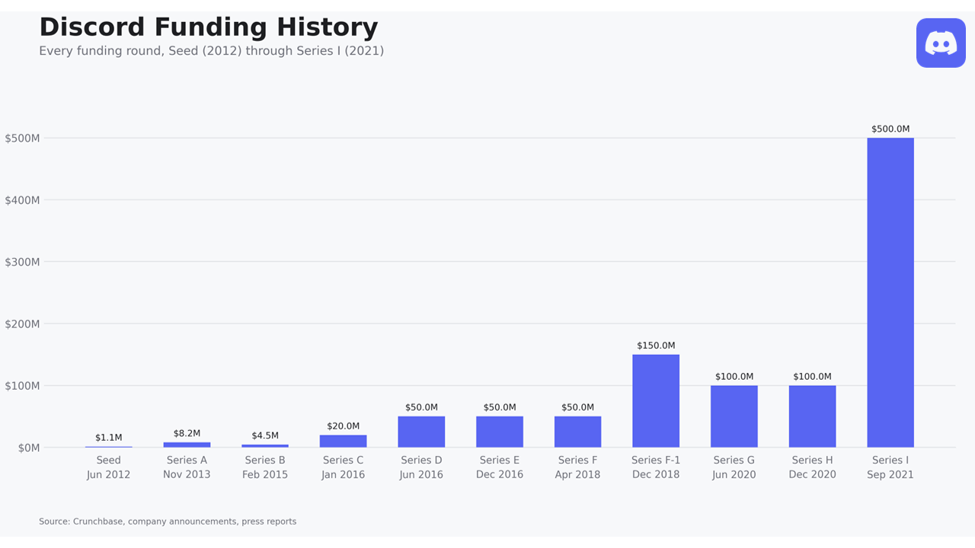
That financing occurred near the peak of private technology valuations, while Discord’s current implied value reflects more recent market pricing and investor expectations. Today, Discord ranks No. 20 in the Prime Unicorn Index, with an implied valuation of approximately $9.12 billion.
The difference between Discord’s current implied value and its 2021 financing valuation highlights an important private-market reality: a funding-round valuation can remain the public reference point long after market conditions change.
Why Tracking Discord Matters
Private companies do not publish quarterly earnings or trade continuously on public exchanges, making changes in value difficult to observe. By incorporating funding rounds, secondary transactions, share-class economics, stock splits, and other corporate actions, the Prime Unicorn Index provides investors with a more current and comparable view of companies such as Discord.
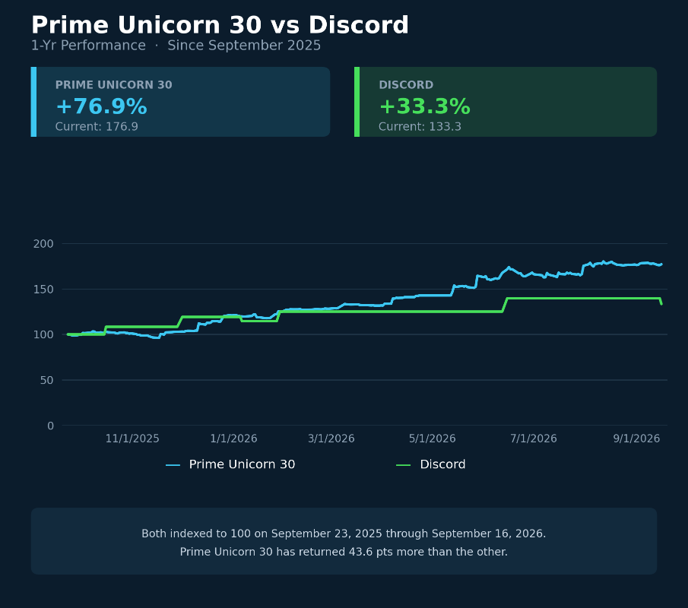
Tracking Discord captures both sides of its investment story: a scaled consumer platform with improving profitability and new monetization opportunities, but also a company valued below its private-market peak. That distinction is especially meaningful after Discord reportedly filed confidentially for an IPO in early 2026.
Looking Ahead
Under CEO Humam Sakhnini, Discord is expanding advertising, commerce, and developer tools while maintaining its focus on gaming and community. Its opportunity is substantial, but so are the execution challenges. The company must grow revenue without weakening the user experience while addressing privacy, moderation, and protections for younger users.
This back-to-school season, Discord demonstrates how online communities have become part of everyday student life. For investors, it also shows why current, institutionally structured private-market data matter long before a company reaches the public market.
Want more data on Unicorn companies, including funding and valuation history, secondary transactions, and more? Email Contact@PrimeUnicornIndex.com or Call 646-290-9254.