
A Top Holding Graduates to the Public Markets
SpaceX, the top-weighted component of the Prime Unicorn 30 Index, priced its initial public offering last night at $135 per share. Shares began trading sharply above the IPO price, opening near $160 and climbing toward the high $160s and low $170s in early trading, a gain of roughly 20–30% over the $135 offer price. The IPO values the company at $1.75 trillion instantly making it the largest IPO in history, roughly three times the size of the previous record-holder. The company begins trading today on the Nasdaq under the ticker SPCX, with 555.6 million Class A shares offered and approximately $75 billion raised.
For the Prime Unicorn Index, this is the moment we’ve been counting down to. As of our April 15 reconstitution, SpaceX sat atop the index at a $1.253 trillion valuation and a 10% weighting, already the single largest component in the Prime Unicorn Composite. Today’s $1.75 trillion debut values the company nearly 40% above that mark, underscoring just how much value creation has continued to occur in the private markets right up until the moment of listing.
What Investors Are Buying
SpaceX’s S-1 gave the public its first real look under the hood, and the picture is more complex than “rockets.” The company now operates across three segments: Space (Falcon 9, Falcon Heavy, Dragon, and Starship development), Connectivity (Starlink, now the company’s largest revenue driver), and AI (xAI, Grok, and X, following SpaceX’s acquisition of xAI in February 2026).
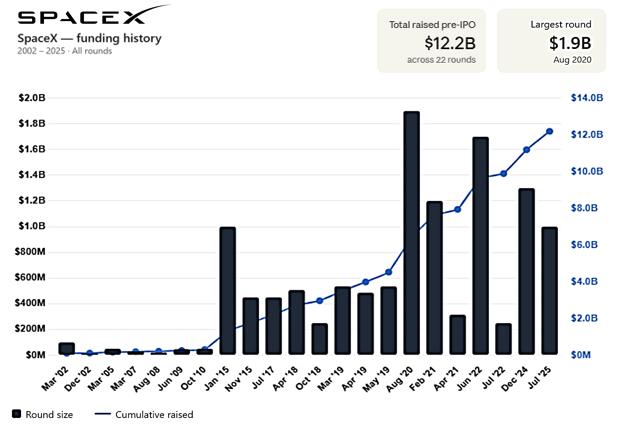
The chart above traces SpaceX’s 22-round, $12.2 billion private funding history, showing how capital raises accelerated sharply in the years leading up to today’s $75 billion public offering.
In 2025, SpaceX generated$18.7 billion in total revenue, up 33% year-over-year, with Starlink alone contributing $11.4 billion, about 61% of the total. Starlink subscribers grew from 2.3 million in 2023 to 8.9 million by the end of 2025, and have since climbed past 10.3 million. Adjusted EBITDA came in at $6.6 billion, though the company posted a GAAP net loss of $4.9 billion for the year, driven largely by a $6.35 billion operating loss in the AI segment.
At $1.75 trillion, SpaceX is trading at roughly 94 times 2025 revenue, a multiple that prices in significant optionality around Starship commercialization, orbital data centers, and the AI buildout. Some analysts, including those at Morningstar, have suggested a “fair value” closer to $600–800 billion based on the underlying businesses alone, meaning today’s price embeds a substantial bet on SpaceX’s long-term ambitions.
Strategic Implications
Demand for the offering has reportedly run roughly 4x oversubscribed, with institutional buyers like BlackRock placing orders in the billions. Retail investors were allocated an unusually large ~30% of shares (versus a typical 10% or less) across Schwab, Fidelity, E-Trade, Robinhood, and SoFi. SpaceX is also set to be fast-tracked into major indexes including the Nasdaq 100 and S&P 500, which should bring structural buying from passive funds in the days ahead. The listing also rippled across related stocks: EchoStar, which owns an estimated 3% stake in SpaceX, surged double digits, while satellite-connectivity peer AST SpaceMobile jumped over 10% on the news.
Founder Elon Musk retains control through his Class B shares (93.6% of that class, carrying 10 votes each), making SpaceX a Nasdaq “controlled company” that has opted out of independent board requirements. Musk’s stake, roughly 42% of the company, could push his personal net worth past $1 trillion on paper, though he is locked up from selling for a year.
For the Prime Unicorn Index, SpaceX’s debut is a landmark validation of our core thesis: that the most significant value creation in today’s economy happens before a company reaches the public markets. SpaceX has been one of our top components since the index’s earliest days, and its graduation to a $1.75 trillion public company, following on the heels of Anthropic’s and OpenAI’s own confidential IPO filings this month, confirms that the private-to-public pipeline we track is more active, and more consequential, than ever.
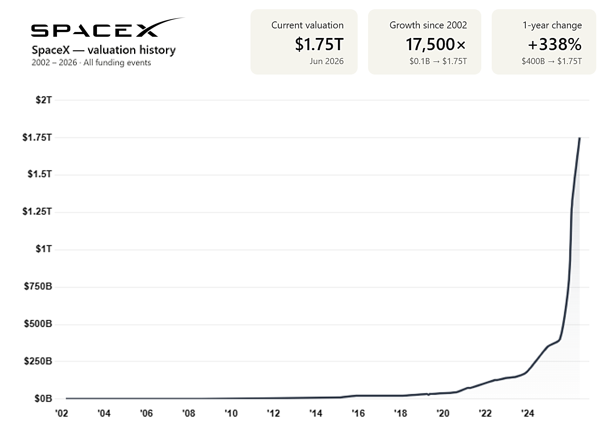
As the chart above illustrates, SpaceX’s valuation has grown roughly 17,500x since its 2002 founding, with today’s $1.75 trillion debut representing the steepest leg of that climb.”
Per Prime Unicorn Index methodology, newly public components remain in the index until the quarterly reconstitution following their 150th trading day, allowing investors to continue tracking performance through the critical post-listing period before the company transitions fully into public-market benchmarks.
Want more data on Unicorn companies, including funding and valuation history, secondary transactions, and more? Email Contact@PrimeUnicornIndex.com or Call 646-290-9254