
Peloton at a Glance
As summer approaches, many consumers are refocusing on fitness, health, and performance. Longer days, warmer weather, and upcoming vacations often drive renewed interest in exercise routines and lifestyle changes. Over the past decade, few companies have shaped the at-home fitness experience more than Peloton Interactive.
Founded in 2012 by John Foley, Peloton set out to reimagine the traditional fitness model by combining high-end exercise equipment with live and on-demand workout content. What began as a connected stationary bike quickly evolved into a broader platform offering classes across cycling, running, strength training, and more.
Peloton’s model centered on a key insight: consumers were willing to invest in convenience and flexibility if they could access high-quality fitness experiences from home. By integrating hardware, software, and subscription-based content, Peloton created a connected fitness ecosystem that allowed users to participate in instructor-led classes without leaving their homes.
The Unicorn Moment
Peloton’s rise to unicorn status was fueled by strong early demand and investor confidence in the connected fitness model. In 2018, the company raised $550 million in a Series F funding round, reaching a valuation of approximately $4 billion and officially becoming a unicorn.
At the time, the fitness industry was undergoing a shift toward digital experiences. Traditional gyms were still dominant, but Peloton differentiated itself by offering a premium, at-home alternative that combined community, competition, and convenience.
As subscription-based services gained popularity across industries, Peloton’s recurring revenue model became increasingly attractive. The company’s ability to blend hardware sales with high-margin subscription revenue positioned it as a unique player in both fitness and technology.
Where Peloton Stands Now
Peloton went public in September 2019 under the ticker symbol “PTON,” marking its transition from a high-growth startup to a publicly traded company.
Since its IPO, Peloton has expanded its product lineup to include treadmills, rowing machines, and a wider range of digital fitness content. The company also broadened its reach beyond hardware owners by offering a standalone app subscription, allowing users to access workouts without purchasing equipment.
During the COVID-19 pandemic, Peloton experienced a surge in demand as gym closures and stay-at-home orders accelerated adoption of at-home fitness solutions. This period marked a significant inflection point for the company, driving rapid growth in both subscribers and revenue, before normalizing in the years that followed.
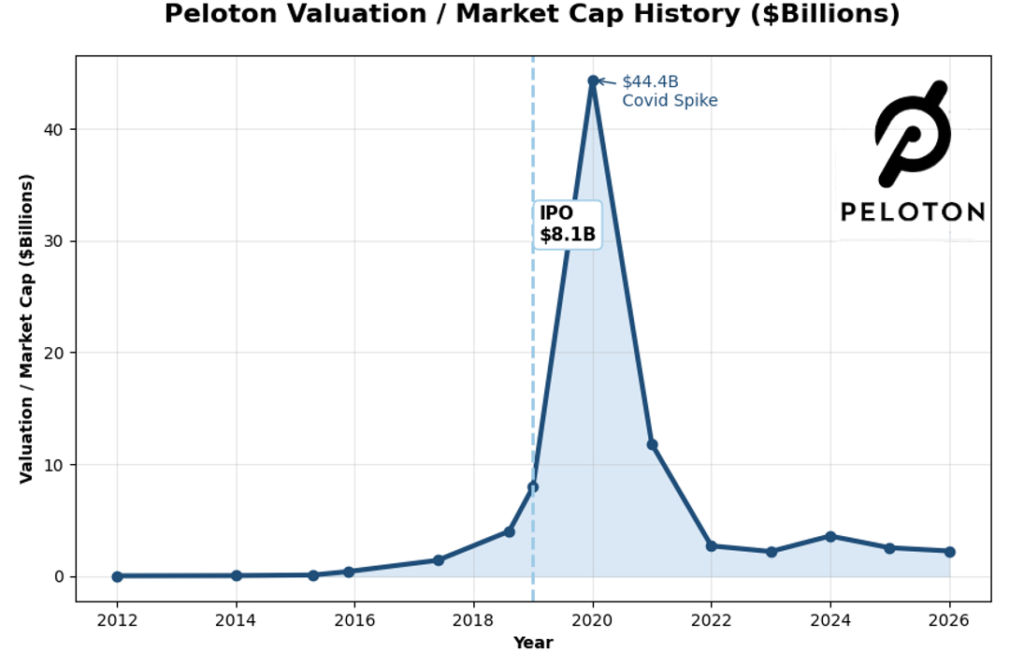
Peloton’s valuation trajectory highlights how much value was created while the company was still private. By the time of its 2019 IPO, Peloton had already reached an approximate $8.1B valuation, following years of growth that took it from early-stage funding to unicorn status in 2018. In contrast, Peloton’s market capitalization today sits significantly below its pandemic-era peak, illustrating how a substantial portion of its value was built prior to public market access. This dynamic underscores a broader trend: much of the value creation in high-growth companies now occurs in private markets, reinforcing the importance of access to private market data.
Market Moves Since IPO
Following its pandemic-driven peak, Peloton faced a period of normalization as consumers returned to gyms and fitness studios. Demand for at-home equipment slowed, and the company adjusted its strategy to focus more heavily on subscriptions, digital offerings, and operational efficiency.
Despite these challenges, Peloton remains a recognizable brand in the connected fitness space. Its platform continues to engage a dedicated user base, and its subscription model provides recurring revenue that supports long-term growth.
More broadly, Peloton’s journey highlights both the opportunities and risks of consumer-focused technology companies. While strong demand can drive rapid expansion, shifts in consumer behavior can significantly impact performance.
Looking Ahead
As summer motivates consumers to re-engage with fitness and wellness, Peloton’s model remains highly relevant. The demand for flexible, at-home fitness solutions continues to persist, even as traditional gyms regain popularity.
Peloton’s ability to combine technology, content, and community helped redefine how people approach exercise. Its rise from startup to unicorn to public company reflects a broader shift toward digital-first lifestyle experiences.
As consumers prepare for summer routines, Peloton stands as a reminder of how innovation can reshape even the most established industries, turning fitness into a connected, on-demand experience.
Want more data on Unicorn companies, including funding and valuation history, secondary transactions, and more? Email Contact@PrimeUnicornIndex.com or Call 646-290-9254