This summer, the world’s biggest sporting event has come to North America. For the first time ever, the 2026 FIFA World Cup is being co-hosted by the United States, Mexico, and Canada, bringing an expanded field of 48 national teams and millions of fans together across the continent. As supporters pack stadiums and crowd around screens for major matchups, many are following the action in a distinctly modern way: through fantasy lineups, live odds, and real-time wagers. Over the past decade, few companies have done more to shape that fan experience than DraftKings.
Founding & background
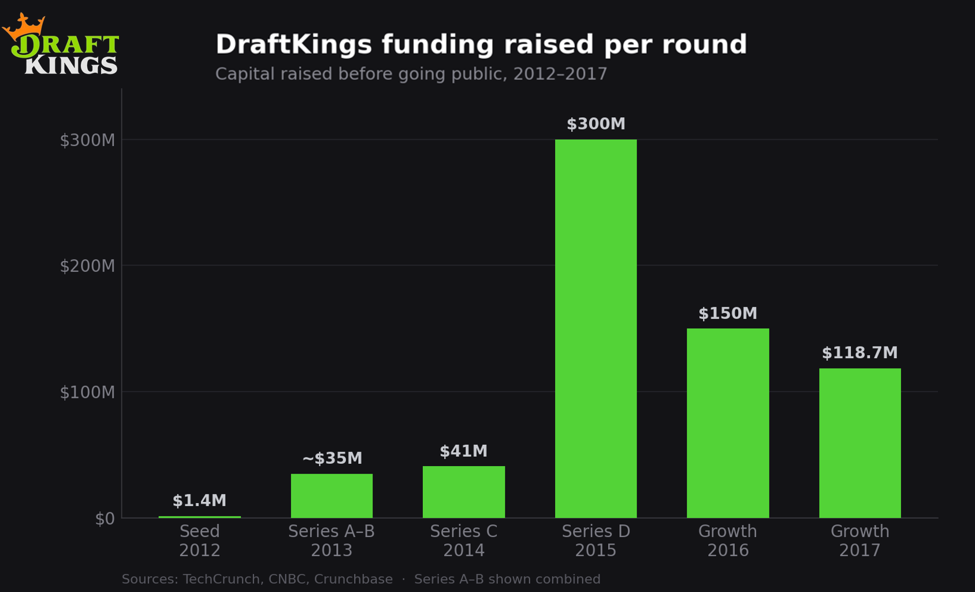
DraftKings was founded in 2012 in Boston by three former VistaPrint colleagues, Jason Robins, Matt Kalish, and Paul Liberman, who started DraftKings out of Liberman’s spare bedroom in Watertown, Massachusetts. Their first product was a one-on-one baseball competition, launched to coincide with Major League Baseball’s opening day in 2012. The pitch was simple: daily fantasy contests that settle in a day instead of a season. Early traction came fast, and by 2014, the company had one million registered players and more than 50,000 daily active users. Notably, in April 2013, Major League Baseball (MLB) invested in DraftKings, becoming the first US professional sports league to invest in daily fantasy sports.
The Unicorn Moment
In July 2012, DraftKings secured its first outside funding, a $1.4 million seed round led by Boston-based Accomplice. In early 2015, Disney invested $250 million in DraftKings, bringing the fantasy company’s valuation close to the $1 billion mark and edging closer towards unicorn status. The defining round came that summer: a $300 million Series D led by Fox Sports that valued DraftKings at roughly $1.2 billion and drew a remarkable lineup of sports-world backers, including the Kraft Group, Major League Soccer, and the National Hockey League. That valuation briefly dipped over the following year, as a wave of state-level legal challenges to daily fantasy sports in late 2015 cooled investor enthusiasm, before recovering as the regulatory picture cleared. In all, DraftKings raised around $715 million in private funding before ever reaching the public markets.
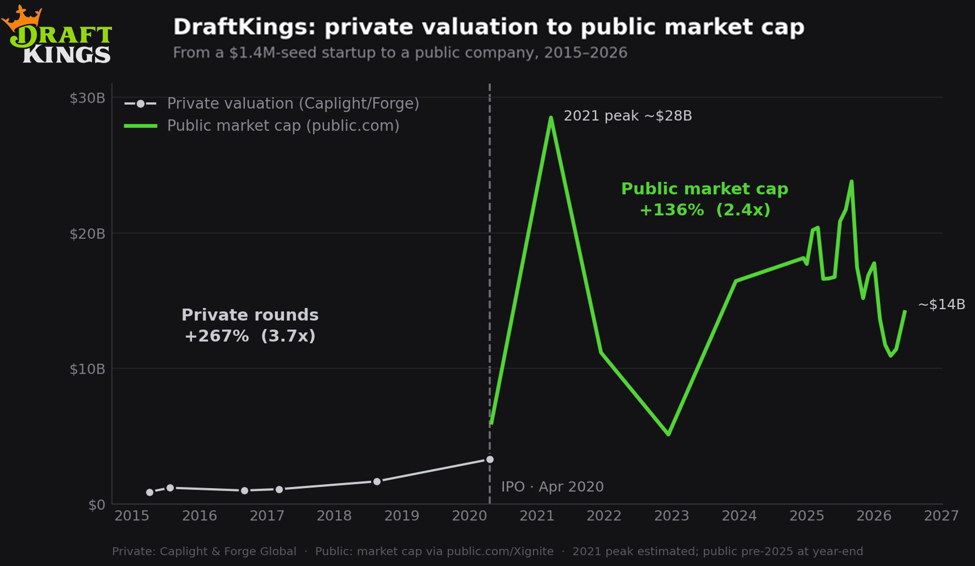
That eight-year private stretch is exactly why early visibility into companies like DraftKings matters so much. By the time DraftKings hit the public markets in 2020, the journey from a spare-bedroom startup to a multi-billion-dollar enterprise had already happened, almost entirely out of public view. The most dramatic value creation, from that first $1.4 million check to a $1.2 billion valuation, unfolded in private rounds that most investors never had a window into. That is the gap the Prime Unicorn Index was built to close: by tracking verified share prices and valuations of leading venture-backed companies, the Index gives investors a reliable benchmark for a market that has long been opaque, so the growth stories no longer stay hidden until the IPO.
Where DraftKings Stands Now
The turning point was legal as much as financial. In 2018, the Supreme Court struck down the Professional and Amateur Sports Protection Act, clearing the way for states to legalize sports betting, and DraftKings moved swiftly from fantasy contests into full-fledged sportsbooks. In April 2020, DraftKings went public through a reverse merger with technology provider SBTech and the SPAC Diamond Eagle Acquisition Corp., a deal valued at $3.3 billion, and began trading on the Nasdaq under the ticker “DKNG.” It was billed as the first pure-play, U.S.-focused sports betting operator to reach the public markets.
Market Moves Since IPO
The company’s growth since the IPO has been striking. Revenue climbed from $323 million in 2019 to roughly $3.7 billion in 2023, and 2024 marked the company’s first full year of positive adjusted EBITDA. DraftKings even set records for revenue and net income in the second quarter of 2025. Today it carries a market capitalization near $14 billion, still below its 2021 peak, and faces stiff competition from rivals like FanDuel along with rising state tax rates. But with the World Cup driving a surge of soccer wagering this summer, DraftKings stands as a reminder of how a daily fantasy idea, born in a spare bedroom, grew into a unicorn that reshaped how fans engage with the games they love.
Want more data on Unicorn companies, including funding and valuation history, secondary transactions, and more? Email Contact@PrimeUnicornIndex.com or Call 646-290-9254