
.
.
A Record That Rewrites the Record Books
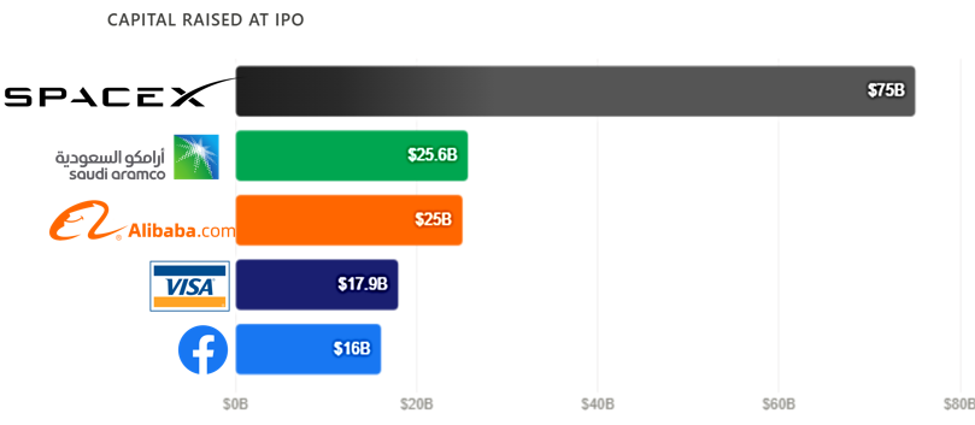
For more than 30 years, the largest IPOs in history were generational events. A state-owned oil giant, a Chinese e-commerce empire, a payments network built during a financial crisis, each raised $15 to $25 billion and held records for years. That era ended on June 12, 2026.
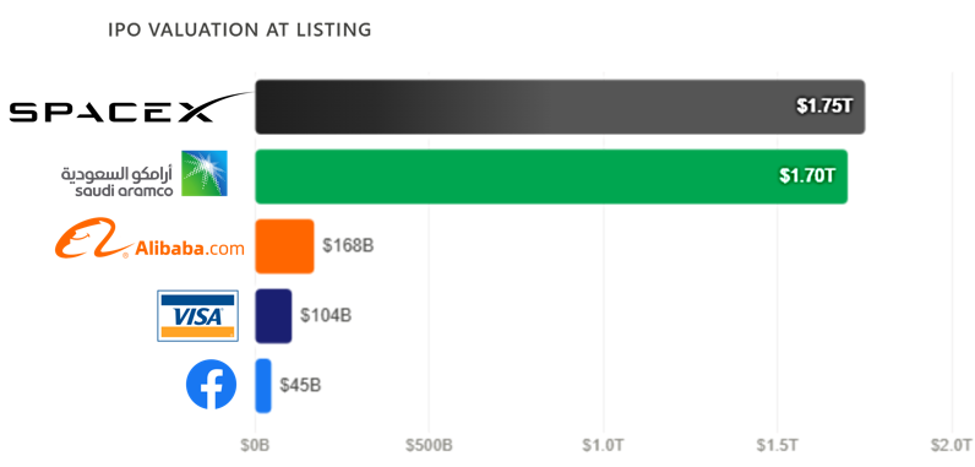
SpaceX, the top-weighted component of the Prime Unicorn 30 Index, raised $75 billion in its Nasdaq debut under ticker SPCX, pricing at $135 per share and valuing the company at $1.75 trillion, the largest IPO in stock market history by nearly three times. Shares closed on IPO Friday at $160.95, a 19% first-day gain, briefly touching a market cap above $2.25 trillion intraday. In the days after, the stock pushed higher still, reaching an all-time high of $225.64 on June 16 and briefly passing Amazon and Microsoft in market value, before a sharp reversal, including a 16% drop on June 22, gave back most of those gains. As of June 25, shares trade near $153, about 13% above the $135 IPO price but roughly 7.95% below their first-day close, leaving the company’s market cap back near $2.02 trillion.
To understand just how historic this listing is, it helps to look at what SpaceX left behind.
The Previous Record Holders
Saudi Aramco (2019), $25.6B Raised: Until this month, Aramco held the record. It priced at a $1.7 trillion valuation, raised $25.6 billion on the Tadawul exchange, and surged 10% on day one. Its original 2016 ambition was a $100 billion raise, but governance concerns and investor pushback forced a scaled-back domestic-only listing. SpaceX raised nearly three times as much, globally, on the world’s most competitive exchange.
Alibaba (2014), $25B Raised: Jack Ma’s NYSE debut was the defining IPO of the 2010s. Priced at $68, shares exploded 38% on day one, with underwriters exercising the greenshoe to bring the total raise to $25 billion. Alibaba debuted at a $168 billion valuation, a figure that looks modest against SpaceX’s $1.75 trillion.
Visa (2008), $17.9B Raised: This raise is perhaps the most instructive comparison for long-term investors. Launched six months before Lehman collapsed, Visa raised $17.9 billion, surged 28% on day one, and today carries a market cap of approximately $600 billion. Durability beat timing, and skeptics were wrong.
Facebook/Meta (2012), $16B Raised: This was the most anticipated tech IPO of a generation, and one of the messiest. Nasdaq technical glitches caused widespread execution failures, and the stock ended day one barely above its $38 IPO price. For investors who held through the chaos, it paid off: a $38 investment has returned over 1,200% since.
How SpaceX Compares
SpaceX raised more in a single offering than Aramco and Alibaba combined. It also entered the public market at a valuation no prior IPO has ever approached, Aramco’s $1.7 trillion debut in 2019 was the only company to ever list above $1 trillion, and SpaceX surpassed it before the first trade was placed.
The Private Market Angle
For the Prime Unicorn Index, SpaceX’s debut carries a meaning beyond the headline numbers. The company spent 24 years private, raising $12.2 billion across 22 rounds before its debut. Investors who held through that entire arc captured value the public market is only now being introduced to.
That is the core thesis of the Prime Unicorn Index: the most consequential value creation happens before a company reaches the public markets. The SpaceX that listed is itself a product of that private arc. In February 2026, it absorbed Elon Musk’s AI company xAI, folding in the Grok models, the X platform, and the Colossus supercomputer. The roughly $1.253 trillion valuation it carried into the IPO already spanned rockets, satellites, and AI. Its move from our top-weighted private constituent to a public company that briefly exceeded $2 trillion is the clearest illustration of that thesis we have seen.
With OpenAI and Anthropic, the #2 and #3 components of the Prime Unicorn 30, both having filed confidentially for IPO, the next chapter of this story is already in motion.
Per Prime Unicorn Index methodology, newly public components such as SpaceX remain in the index until the quarterly reconstitution following their 150th trading day, allowing investors to track performance through the critical post-listing period before the company transitions fully into public-market benchmarks.
Want more data on Unicorn companies, including funding and valuation history, secondary transactions, and more? Email Contact@PrimeUnicornIndex.com or call 646-290-9254.