Healthcare is one of the broadest and most consequential segments of the Prime Unicorn Index Composite, spanning health insurance, care delivery, biotechnology, diagnostics, clinical research, and the frontier of medical devices. Because so much of healthcare’s innovation now happens inside private companies, the sector is a clear example of why consistent private-market visibility matters. The Prime Unicorn Index helps track where capital, innovation, and value creation are occurring across healthcare long before these companies reach the public markets.
The Prime Unicorn Composite Index currently includes 36 healthcare companies, making it the third-largest sector in the index, behind only Enterprise SaaS and Consumer/Marketplace. Together, those companies represent approximately 10.0% of the composite’s Q2 2026 weight. Seven of those are also represented in the Prime Unicorn 30™ Index: Devoted Health, Neuralink, Resilience, Ro, Benchling, Lyra Health, and Reify Health.
What sets healthcare apart from other sectors is its sheer range. Where a sector like fintech clusters tightly around financial infrastructure, the index’s healthcare names stretch across the entire industry. The healthcare industry spans everything from the companies that pay for care to those that deliver it, the biotech engine behind new medicines, and the frontier where technology meets the body. Few sectors in private markets cover that much ground.
Sector Performance
From June 24, 2025 through June 24, 2026, the PUI Healthcare Industry Average returned 17.9%, compared with 75.3% for the Prime Unicorn 30™ Index, an underperformance of 57.4 percentage points. The seven healthcare companies in the Prime Unicorn 30 returned a positive 18.5%, closely tracking the broader healthcare group.
Performance beneath the headline was highly uneven. Within the index data, BillionToOne and Neuralink were the largest positive contributors, adding roughly 15.3 percentage points combined. Commure, Noom, and Nomi Health were the largest detractors, subtracting about 1.4 points combined. This dispersion shows why a sector benchmark is useful: it captures both standout repricings and weaker marks that a single-company story can miss.
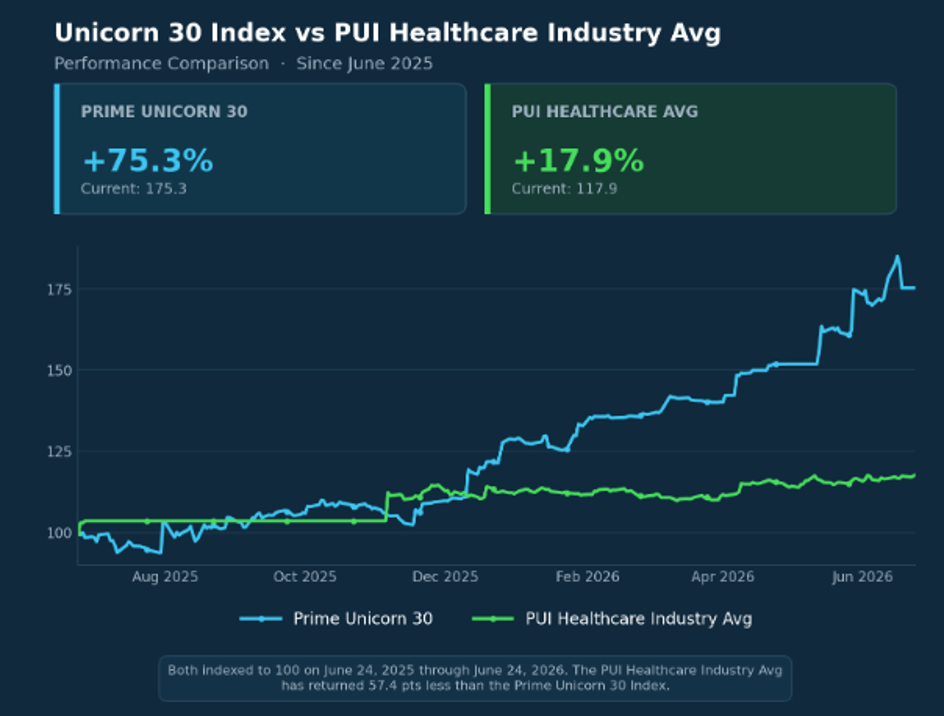
This kind of sector-level view is exactly what private-market data is built to provide: a way to see not just which individual companies are growing, but how an entire segment of the unicorn market is performing relative to the broader index. which sectors are leading, lagging, or recovering.
Key Theme: The Index’s Most Diverse Sector
The clearest theme in healthcare is breadth. The seven names in the Prime Unicorn 30 map neatly onto the structure of the industry itself.
The index’s largest healthcare component, Devoted Health, is a technology-driven Medicare Advantage insurer that pairs its own health plans with an in-house clinical arm. It is also one of the sector’s fastest growers, up 20% and expanding to more than 466,000 members in early 2026.
A second group is rethinking how care is delivered. Ro has built a vertically integrated, direct-to-patient platform that combines telehealth, labs, and pharmacy in one experience, with demand for GLP-1 weight-loss treatment driving much of its recent growth. Lyra Health brings the same digital-first logic to mental health, providing AI-powered behavioral-health benefits to large employers.
A third group powers the science behind new medicines. Resilience is a technology-focused biomanufacturing company built to produce complex therapies, biologics, vaccines, and cell and gene therapies, with a focus on a resilient, domestic supply chain. Benchling provides the cloud R&D platform that life-sciences teams at companies like Gilead, Sanofi, and Regeneron use to run their research. Reify Health builds the software that helps biopharma giants such as Amgen, AstraZeneca, and Eli Lilly enroll patients in clinical trials faster.
And then there is the frontier. Neuralink, the second-largest healthcare name in the index, is Elon Musk’s brain-computer interface company. Neuralink develops implants that let people control devices with their thoughts. By late 2025, it had placed implants in roughly a dozen recipients across four countries. Musk is no stranger to this index; he also founded SpaceX, the Prime Unicorn 30’s top-weighted component, and Neuralink shows just how far healthcare’s frontier now extends, from insurance plans on one end to neural implants on the other.
Why the Healthcare Sector Remains Important
Healthcare’s defining feature within the index is that it refuses to fit a single narrative. AI may dominate today’s private-market headlines, but healthcare is where many of those advances actually reach people. A sector that runs from Medicare Advantage to brain-computer interfaces is, almost by definition, one of the most resilient and diversified corners of the private market.
For investors and market observers, the Prime Unicorn Index Healthcare Industry Average offers a clearer view into this segment, helping benchmark performance, surface emerging trends, and understand where the next wave of value creation in healthcare may be taking place.
Want more data on Unicorn companies, including funding and valuation history, secondary transactions, and more? Email Contact@PrimeUnicornIndex.com or Call 646-290-9254.